Showing posts with label death. Show all posts

Friday, September 17, 2010

The Eventual Result of Healthy Living

Everyone enjoys a good prediction about their own death, right?

Well, I guess a good prediction, as in, an actionable one, would tell you something specific about the time and manner of your death so that you could prepare (all you need to know: man-eating anteaters).

But this good-humored Death Clock runs a little calculation based on a few simple factors (date of birth, body mass index, sex, country of residence and whether or not you smoke) and predicts a date for you. I could hardly be expected to resist, could I?

Check it out:

My Death Clock Calculation

So now at least I know when the man-eating anteaters are going to get me. Since it's a Monday, I'll be able to take some comfort in the fact that at least I didn't have to make it through another week.

I assume it's based on average life expectancy tables for various countries, and it could be interesting to compare how long you might live in the U.S. to how long in Canada and so forth, but then again, you could look that stuff up elsewhere more easily.

The real hook here is that this pretends to be personalized. Seriously, make anything that gives a result based partly on personal information, and someone will think it's worth doing.

I blame Dangerous Intersection for thinking it was worth doing before I did.

.

Wednesday, June 16, 2010

Things I Rarely Worry About

Slate muses on a question that has, happily, not been much on my mind: if you're going to be executed, what's the best way to go?

It turns out that the firing squad, while it may seem a bit crude, isn't a bad choice. It's pretty quick and certain, which I guess is what you're going for in this situation.

Key lines: "A Utah inmate who in 1938 agreed to be gunned to death while hooked up to an electrocardiogram showed complete heart death within one minute of the firing squad's shots. By contrast, a typical, complication-free lethal injection takes about nine minutes to kill an inmate."

So in terms of pure speed, take the bullets.

There's some interesting speculation on why U.S. society seems to prefer lethal injection, if it's true that the firing squad is quicker, with the conclusion that lethal injection just seems tidier and more clinical.

We want to kill people, but let's not get all messy or anything. This is clean, impartial justice.

The article doesn't talk about beheading, although I seem to recall that the guillotine was invented as a humane method of execution that would remove the head with one clean cut--and I'm not sure "complete heart death" is something you need to worry about if your head isn't attached to your body.

Beheading is definitely not going to fall into the "tidier and more clinical" category, but evidence-based execution would demand that we base our actions on the facts, without regard to personal distaste.

So if you're considering this question, I would recommend holding off on a decision until you get that information.

.

Thursday, April 22, 2010

[Shudder]

Aunt B. at Tiny Cat Pants is musing on the idea that when you get that sudden chill down your spine, it's because someone walked over your grave.

Where did this phrase even come from? Is it a cool notion of a sharp, backwards tug of time that present me can feel something that will happen long after I am dead? Or is it more the idea that there is a patch of land already destined for me, that it and I are tied together even now, without me knowing it, its purpose already plotted–that it will hold my dead corpse–and when someone walks across it, I know it because of that tie?

I like this phrase too, and I always kind of imagined it to have the second meaning, that somewhere out there is a patch of ground that's going to be my grave, and when someone walks across it, it reverberates back to me...spooky.

Of course, I actually think I'd prefer to be cremated and scattered in the woods or something, but "someone walked over one of the miles of ground on which fragments of my strewn ashes will eventually lie" doesn't have the same ring, does it?

There's something about a grave.

.

Saturday, November 7, 2009

Readin' Comics

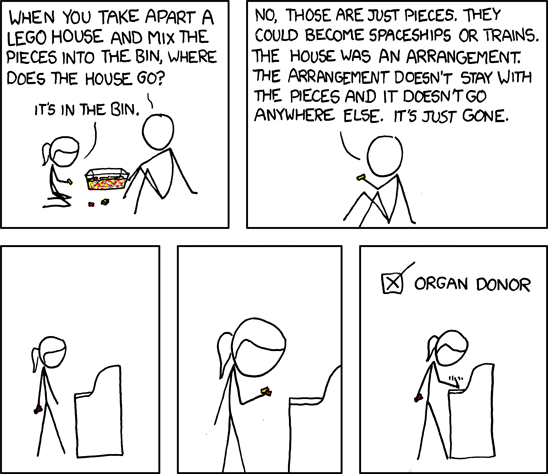
Interesting xkcd comic today, reflecting on what happens after we're disassembled into our component parts and tossed into the bin.


From xkcd, under Creative Commons license


I don't at all remember which of his books it was, but I recall Isaac Asimov made an argument similar to this, using the idea of building an intricate castle out of wooden blocks and knocking it down, and explicitly discussing how this compares to human consciousness and death.

All the bits are still there (blocks, neurons), but the castle (or the person's consciousness) no longer exists. It existed as a combination of specific materials organized in a specific form. The castle was real, unique, magnificent perhaps depending on much effort you put into it, but once it's in pieces, it's gone.

It can linger as a memory, in pictures maybe, in legends of block construction to be passed down to future generations of builders, but there's no afterlife of wooden block castles where it still exists.

And if that's true of human consciousness, then indeed, we've got no real reason* not to check that 'organ donor' box. Someone else may as well get some use out of those component parts I no longer need. (This is not to say that I think believing in consciousness that persists after death means someone wouldn't check that box--this is certainly not true.)


*Well, some of us may have poisonous organs and wish to spare others from their terrible curse. That's a pretty good reason.

.

Sunday, January 18, 2009

Approaching Death

GruntDoc highlights this interesting post from Aggravated DocSurg called Four Horsemen of a Trauma Death.

It talks about exactly what might be happening in and to your body if you happen to get drunk and drive your car into a tree on a cold winter's night (as so many of us do), using the Four Horsemen of Hemorrhage, Hypothermia, Time, and Death to cover the details.

It reminded me of Peter Stark's grim but fascinating book Last Breath, which similarly covers the details of what's going on physiologically as humans die from various causes. What's going on as you freeze to death? Die of dehydration? Weaken from scurvy?

There's something very compelling about the idea of knowing and understanding these points. Partly, I guess, the demystification makes the process seem less scary (not that I personally would probably be any calmer if I were actually about to expire from heatstroke or something). It's still not desirable, but it makes sense. We like things to make sense.

And partly, it's just wildly amazing how things work, and exactly how they come apart if they're not working anymore. Biological processes are so fascinating. 

And gross. Very, very gross.